


Portable desalination kit 45L/h
- Suitable for multiple scenarios, easy to install and upgrade, low cost.
- Smple connection, quick start-up, space-saving.
- Intelligent control, one-button start/stop, no professional personnel required.
- Suitable for water temperatures of 5-45°C, treats seawater ≤30000ppm, customizable.
- Multi-stage filtration + reverse osmosis, with customizable options for higher requirements.
Kysearo portable desalination kit is a practical seawater desalination device developed specifically for marine applications. With its flexible design, it can precisely meet the daily freshwater needs of ships and offshore platforms, while also providing a stable and reliable solution for freshwater supply in emergency situations.
Beyond its core maritime applications, the system’s scope extends to emergency water supply for island disaster relief, water supply for coastal cities facing water shortages, and daily water supply for island hotels. It can also provide robust support for water demand during island development and construction projects.
Technical Parameters
Model NO.: KY-4021
Water yield: 45L/H
Outline Dimention: 47*31*21CM/60*28*18CM
Water Outlet: TDS <700
Water Inlet: TDS <40000
Power: 240W
Voltage: DC24V(DC12V
Current: 10A(20A)
Weight: 55KG

Advantages of portable desalination kit
Disruptive energy-saving technology: Self-developed energy recovery device reduces energy consumption by 80% compared to non-recovery equipment, significantly reducing long-term operating costs.
Drinking water-grade purification: TDS <700 ppm (far below the national drinking water standard of ≤1000 ppm), suitable for direct consumption.
Quiet design: Noise level <60 decibels at 1 meter (equivalent to indoor conversation volume), nearly imperceptible in a marine environment.
Minimal operation and maintenance
Integrated modular design, dimensions less than 0.5 m³;
Front-mounted SUS 316 stainless steel filter is washable, and the RO membrane only needs to be replaced every 2 years (can be extended to 3-5 years with low-frequency use).
Technical Principle
Using high-pressure reverse osmosis desalination technology, seawater is safely converted into fresh water through multi-stage precision filtration (SUS 316+RO membrane). The fresh water is discharged through a dedicated pipeline (supports 3-inch (9.52 mm) PE pipe connection).
Få en løsning nu

How does portable desalination kit work?
1. Before each start-up, first turn the flushing ball valve to the parallel position with the pipeline. The high pressure meter has no pressure.
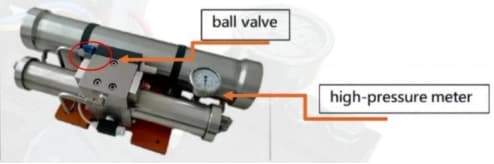
2.Turn on the pump and start the switch. The external switch connected to the start switch can be used to start it.
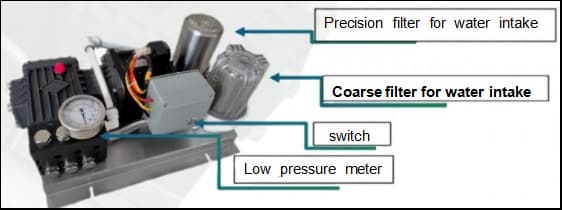
3. After the water flow stabilizes,turn the ballvalve to a position perpendicular to the water pipe. The low-pressure pressure gauge will increase, and it will shake every few seconds. The high-pressure pressure meter will also shake while the pressure increases. The pressure gauge readings vary with different salinity levels. Normal, the low-pressure pressure should not exceed 1Mpa, and the high-pressure pressure should not exceed 5.5Mpa. Both can be used normally. If exceeded, there will be two scenarios:
(1) The salt content of the incoming water is too high.
(2) RO filter element blockage.
4.When the water pipe starts to produce water normally,the equipment can work normally.
How does portable desalination kit maintenance?
1. Check for any leaks in the pipes after each startup.
2. If it is placed for too long, try to open the mechanism once a month.Avoid crystallization of internal seawate or blockage of internal sliding valve due to scale, so as to preven the system from working normally.
3.Depending on usage, also inspect the inlet water coarse filter. The internal stainless steel filter element can be seen through the transparent cup. If is too dirty, you can unscrew the filter cup counterclockwise to remove and clean it. This ensures the normal workingn of the pump. Note that sealing parts must hot be lost.
4. Inlet water precision filter. Use a wrench to turn the filtercup nut to remove it. Clean it with water or a brush, reinstall it. Be careful not to lose the seal. It is recommended to clean it once a year. If the usage frequency is low, the cleaning interval can extended based on usage conditions.
 Danish
  English
  Arabic
  Spanish
  Russian
  German
  Indonesian
  Romanian
  Vietnamese
  Turkish
  Thai
Thai  Italian