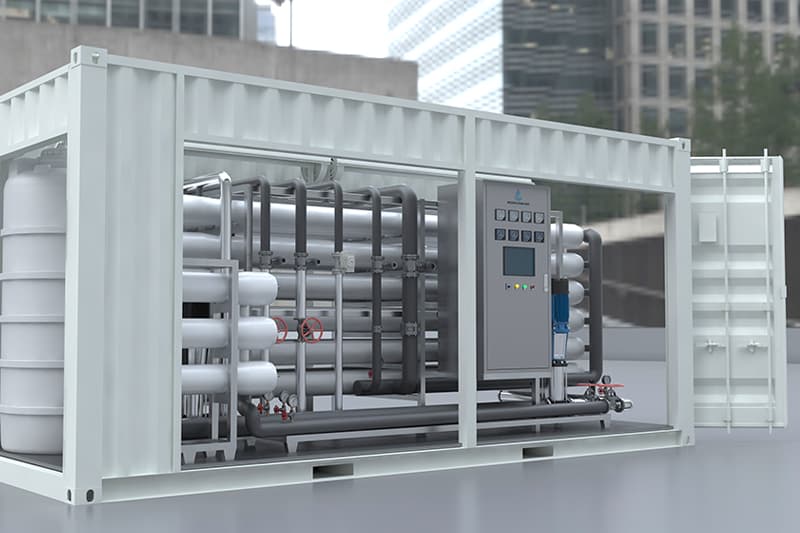
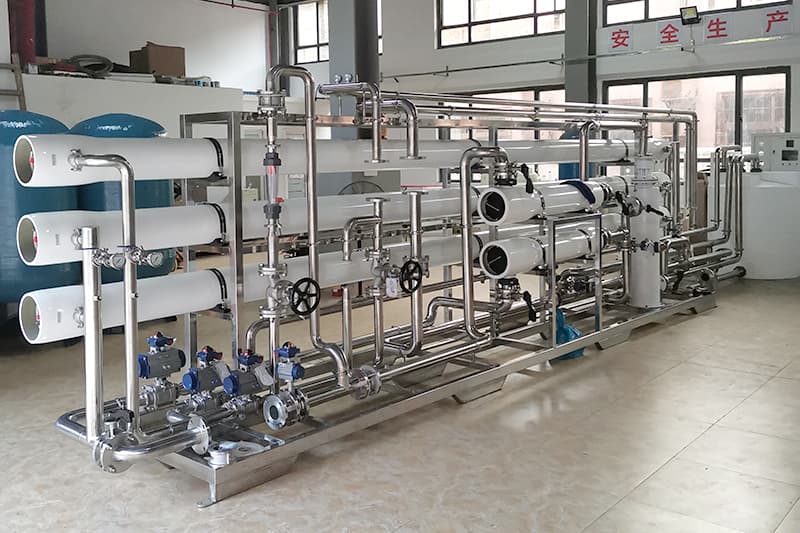
Industrial reverse osmosis system is a key equipment in water treatment processes, and its stable operation is directly related to production compliance and water quality safety. This article will compile answers to seven key questions regarding the maintenance of industrial reverse osmosis systems and support enterprises in establishing scientific and effective regulation systems;
Why does industrial reverse osmosis system need maintenance?
Reverse osmosis is a high-precision water treatment plant that uses pressure to drive water through a semi permeable membrane, thereby removing dissolved salts, microorganisms, and other impurities! Its core component, the reverse osmosis membrane, has a filtration accuracy of up to 0.0001 micrometers and can effectively remove over 98% of dissolved salts and microorganisms in water. About 60% of industrial reverse osmosis system failures are caused by improper operation or lack of maintenance! Regular maintenance not only ensures stable water quality, but also extends the service life of membrane components from 3 years to over 5 years, saving enterprises millions of yuan in replacement costs annually.

How to build an effective daily monitoring system?
Establishing a comprehensive daily monitoring system is the primary step in preventing reverse osmosis system failures! The monitoring of key parameters should include core targets such as inlet pressure, inter segment pressure difference, and produced water conductivity!
Monitoring parameters and frequency are advocated as follows:
- Inlet pressure: Recorded every 2 hours, shocking and leading by ± 15%, requiring warning -Inter segment pressure difference: Check daily and clean immediately if it is ≥ 0.2MPa
- Conductivity of water production: Real time monitoring, triggering an alarm when it rises by 10% -Inlet water temperature: Record every 4 hours, and adjust if exceeded
A certain steel enterprise successfully extended the service life of membrane components from 3 years to 5 years by implementing the above-mentioned monitoring system, saving an annual cost of $0.2 million. In addition to the standard parameters, it is also necessary to regularly check the water pollution index (SDI15) to ensure that its value does not exceed 5 . Otherwise, low-pressure flushing should be carried out immediately;

How to maintain the pre-treatment system?
The preprocessing system is for reverse osmosis settings, and its operational status directly affects the lifespan of membrane components; The preprocessing system mainly consists of mesh multi-media filters, activated carbon filters, and security filters.
| Componentse | Maintenance | Maintenance Frequency | Replacement Cycle |
|---|---|---|---|
| Multi media filter | Backwash when pressure difference ≥ 0.07MPa | Backwash every 1-3 days | Quartz sand replaced annually |
| Activated carbon filter | residual chlorine in effluent<0.1ppm | residual chlorine detection per shift, backwashing every 7 days | activated carbon replacement every 6-12 months |
| Security filter | Replace filter element when pressure difference is ≥ 0.05MPa | Check pressure difference daily | Replace filter element every 3-6 months |
| Softening resin | Set regeneration time based on water production | Add regeneration agent every 3-4 days | Resin exchange every 10-24 months |
The ineffectiveness of the preprocessing system can directly lead to confusion of the reverse osmosis membrane! A certain semiconductor factory caused 0.5 μ m particles to scratch the surface of the membrane due to failure to replace the security filter element in a timely manner.

How to clean and maintain reverse osmosis membrane components?
Reverse osmosis membranes performance depends on scientific cleaning and maintenance strategies. The cleaning opportunity should be determined based on the compiled operating parameters: when the water production decreases by 10% -15%, the desalination rate decreases by 3% -5%, or the pressure difference increases by 15%, chemical cleaning is required;
The chemical cleaning selection:
- Inorganic scaling: Using a 2% citric acid solution (pH=2-3) for 1 hour of cyclic cleaning, effectively removing calcium carbonate and calcium sulfate scales
- Organic pollution: Clean with 0.2% NaOH+0.025% sodium dodecylbenzenesulfonate solution (pH=11-12)
- Microbial contamination: Add 0.1% non oxidizing bactericide in alkaline cleaning
- Metal oxides: Adopting EDTA tetrasodium salt (pH=10) complexation cleaning, manganese and other sediments
When cleaning, follow the standard procedure: first, circulate the cleaning solution at a low flow rate (about 1/2 of the design flow rate), then rinse at a high flow rate (about 1.5 times the design flow rate), and finally rinse with pure water until the pH is neutral! A certain power plant discovered a 20% decrease in water production and successfully restored 95% of the membrane element flux through citric acid cleaning.
For preparation shutdown cherish , short-term shutdown (≤ 15 days) requires low-pressure flushing every 2 days; Long term shutdown (>15 days) should be treated with 0.5% -1% sodium bisulfite protective solution and supplemented with monthly testing.
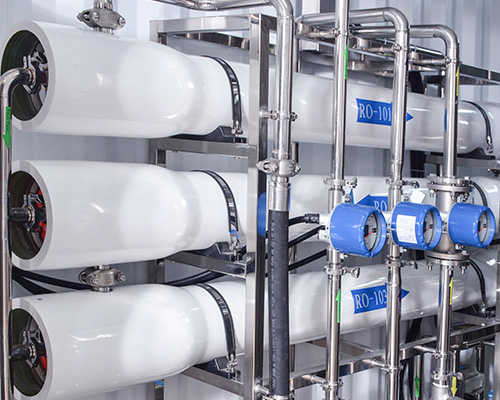
Which auxiliary staffing needs to be synchronously maintained?
The stable operation of the reverse osmosis system relies on the collaborative work of multiple auxiliary systems, and maintaining the high-pressure pump is a key link in this process. Lubricating oil should be replaced every 3 months and bearing temperature should be checked (to ensure ≤ 70 ℃); Replace the plate stagnation seal every 6 months to prevent leakage and low pump efficiency!
Instrument calibration is equally important:
Conductivity meter: calibrated with standard solution every month, with an error margin of ± 2% that needs to be adjusted or replaced. Pressure gauge: Replace it every quarter when compared with the tight pressure gauge and the deviation is greater than or equal to 5%
Regular maintenance is also required for dosing preparation, and the dosage of scale inhibitors should be adjusted according to the LSI index (usually 3-5ppm) to prevent calcium carbonate scaling. Non oxidizing fungicides (such as DBNPA) are recommended to be added once a week, with a concentration controlled between 20-30 ppm;

How to diagnose and handle common faults?
Common faults in reverse osmosis equipment mainly include decreased water production, excessive water conductivity, and abnormal equipment vibration;
The troubleshooting process for the decrease in water production should be: detecting the inlet pressure → detecting the pressure difference of the security filter → measuring the pressure difference between sections → identifying the SDI value → conducting membrane element integrity testing. A power plant discovered a 20% decrease in water production, which was diagnosed as calcium sulfate scaling caused by interruption of scale inhibitor dosing. After cleaning with citric acid, 95% of the flux was successfully reduced;
The diagnostic tree for excessive conductivity of produced water includes: checking the fluctuation of inlet water pressure → testing the desalination rate of membrane components → analyzing the dosing system → testing the sealing performance of O-rings. A pharmaceutical company once encountered problems due to the increase in water conductivity from 5 μ S/cm to 120 μ S/cm, and ultimately restored the system to normal by replacing the damaged concentrated water seal ring!
Set up vibration anomaly handling facilities as follows: tighten anchor bolts → calibrate pump alignment → check coupling clearance → evaluate pipeline stress; Preventive measures include adding elastic flexible joints at the inlet and outlet of high-pressure pumps, which can effectively reduce vibration levels!
How to develop a maintenance plan to ensure the long-term operation of the system?
Establishing a hierarchical maintenance system is the key to ensuring the long-term static operation of reverse osmosis equipment; We recommend the following maintenance frequency schedule:
Daily maintenance (per shift): Check the vibration and temperature of the pump body (ensure ≤ 65 ℃), confirm the opening of all valves, record operating data and generate trend charts
Weekly maintenance: Verify the accuracy of the pressure gauge and flow meter, check the electrode status of the conductivity meter, and clean the inlet filter screen of the high-pressure pump
Monthly maintenance: Testing the safety valve popping pressure (1.1 times the design pressure), checking the sealing of the membrane element end cover, evaluating the pre-treatment preparation results (SDI15 ≤ 5)
Annual maintenance: Entrust a professional organization to conduct membrane performance testing (desalination rate, flux attenuation rate), comprehensively inspect the insulation performance of the electrical system, and evaluate the energy efficiency (electricity consumption per ton of water) of the installation
Discretionary use of digital management tools to improve maintenance efficiency, such as deploying intelligent monitoring systems with integrated parameter visualization mind boards, voluntary abnormal alarms, maintenance plan reminders, and other functions; A certain automotive parts company has shortened its fault response time from 2 hours to 15 minutes and reduced non intentional downtime by 48 hours annually through digital transformation;
Conclusion
The maintenance of industrial ro plant includes system engineering that includes pre-processing, auxiliary preparation, and fault management! By establishing the control concept of “preventive maintenance as the mainstay and corrective maintenance as the supplement”, enterprises can significantly improve equipment reliability and economy;
Get The Solution Today!
 Italian
  English
  Arabic
  Spanish
  Russian
  Danish
  German
  Indonesian
  Romanian
  Vietnamese
  Turkish
  Thai
Thai