


Reverse osmosis (RO) system is mainly designed to remove all kinds of solvent solids, colloids, and organics. How to select the right membrane element? These following facts should be taken into consideration, including salinity of feed water, rejection rate, good chemical stability, higher anti-pollution quality and good mechanical intensity.
According to the times of raw water passing through the RO membrane, RO device is classified into the 1st pass, 2nd pass and even multilevel pass RO device. 1st pass and 2nd pass RO are generally used, so what the difference between 1st and 2nd seawater RO plant.
1.Difference in technological process
Single-stage RO system: Employs a “pretreatment + single-stage membrane separation” basic architecture. Raw water sequentially passes through pretreatment units such as a multimedia filter (removing suspended particles), an activated carbon filter (adsorbing organic matter and residual chlorine), and a 5μm security filter (fine filtration), then is pressurized by a high-pressure pump (typical pressure 1.5–2.5 MPa) and enters the single-stage RO membrane module. During this process, the water flow is separated into two streams: product water and concentrate. The product water enters the storage tank, while the concentrate is either directly discharged or partially reused.
 Two-stage RO system: This system adopts a series architecture of “pretreatment + first-stage RO + second-stage RO.” The product water from the first-stage RO is not directly sent to the storage tank but is instead pressurized again by a second-stage high-pressure pump (typical operating pressure: 1.0–1.8 MPa) and fed into the second-stage RO membrane module. This design enables the first-stage product water to undergo secondary refinement, significantly enhancing the final product water purity. It is worth noting that a intermediate alkalization system (such as a NaOH injection system) is typically installed in the two-stage RO system to adjust the pH of the first-stage product water, converting CO₂ into easily removable HCO₃⁻ ions, thereby significantly improving the desalination efficiency of the second stage.

2 pass ro
2. Difference in configuration
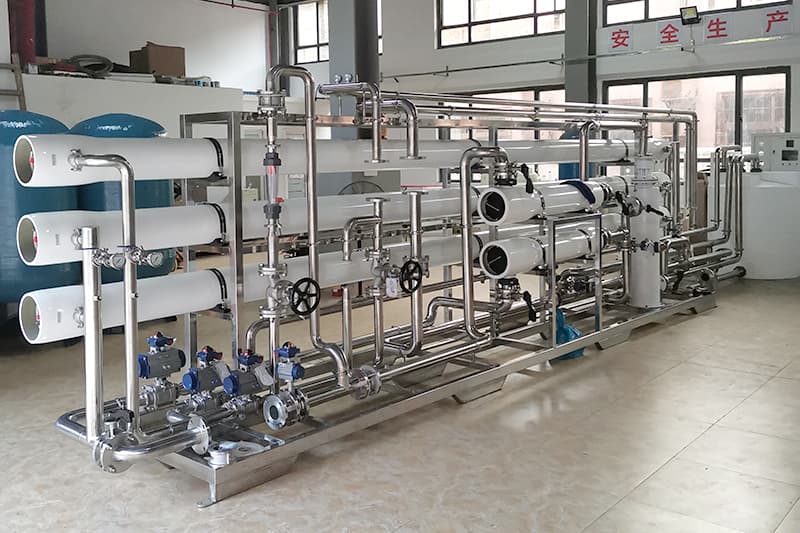
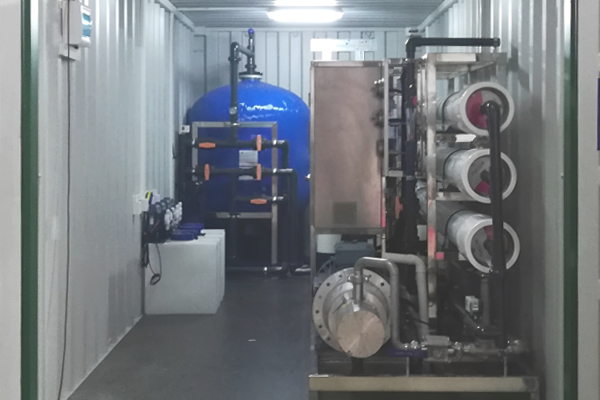
In actual engineering applications, the first-stage RO and second-stage RO systems have distinct visual differences:
First-stage RO system: Equipped with a single vertical high-pressure pump, the piping layout is relatively simple, and the control system primarily monitors basic parameters such as feedwater pressure, product water conductivity, and system recovery rate.
Two-stage RO system: Equipped with two high-pressure pumps (primary and secondary pressure pumps), an intermediate water tank, and a chemical dosing unit. The instrumentation system is more complex, requiring simultaneous monitoring of operational parameters and performance metrics for both stages.
| Components | 1st pass RO | 2nd pass RO |
|---|---|---|
| Number of High-Pressure Pumps | 1 unit | 2 units |
| Number of RO membranes | Single membrane module | Two-stage membrane modules in series |
| Instrument monitoring | pressure, conductivity | Dual-stage pressure, water quality, and flow monitoring |
3. Difference in Water Quality, Efficiency and Operation
a. Difference in the quality of produced water
- Comparison of desalination efficiency: the removal rate of total dissolved solids (TDS) in the water of the primary RO system is usually 95-97% under the standard operating conditions, which means that the conductivity of the produced water is about 15-25μS/cm when the conductivity of the raw water is 500μS/cm, while the secondary RO system, through the two-stage separation process, can increase the desalination rate to more than 99%, and under the same raw water conditions, the conductivity of produced water can be reduced to less than 5μS/cm. Under the same raw water conditions, the conductivity of produced water can be reduced to below 5μS/cm. This water quality improvement is especially important in the electronics industry, because the conductivity of chip cleaning water needs to be controlled below 10μS/cm to avoid the decline in yield caused by ionic contamination.
- Removal of special pollutants: The secondary RO system has a significant advantage in the treatment of boron, silicon and other difficult to remove substances. The removal rate of boron by primary RO is usually 70-85%, while the secondary system can be upgraded to more than 95%. This is critical in the photovoltaic industry and the nuclear industry, where boron levels are extremely restricted (typically <0.5mg/L). Similarly, for silicon removal, the secondary system can further reduce the silicon content from 0.1-0.5mg/L in the primary produced water to 0.01-0.05mg/L, meeting the stringent requirements for high pressure boiler make-up water.
b. System Recovery Rate and Operating Pressure
- Water Utilization Efficiency: The typical recovery rate of primary RO system ranges from 50-75%, which means that 25-50% of the influent water is converted into concentrated water for discharge. The secondary RO system can achieve 85-90% system recovery through concentrated water return and optimized design, significantly reducing wastewater discharge. For example, in the Zero Discharge of Wastewater (ZLD) project, the concentrated water of the secondary RO can be partially refluxed to the primary feed water, increasing the overall recovery rate to more than 90%, and significantly reducing the load of the subsequent evaporation and crystallization unit and treatment costs.
- Operating pressure and energy consumption characteristics: the first RO system high-pressure pumps need to overcome the high osmotic pressure of the feed water, the operating pressure is usually 1.8-3.0 MPa, while the second RO system due to the feed water is already the first level of water (TDS significantly lower), its osmotic pressure has dropped dramatically, so the second stage of the operating pressure of only 1.0-1.8 MPa Although the second level of the system has two sets of high-pressure pumps, but due to the second stage of the working pressure is lower, its overall energy consumption Although the secondary system has two sets of high-pressure pumps, due to the second stage of the working pressure is lower, the increase in energy consumption is limited (about 15-25%), while the quality of produced water has been a qualitative leap.
Comparison of performance parameters between primary RO and secondary reverse osmosis system
| Parameters | One stage RO system | Two stage RO system | Enhancement effect |
|---|---|---|---|
| Desalination rate | 95-97% | 99% or more | improve 2-4 % |
| Conductivity of produced water (μS/cm) | 15-25 | <5 | 3-5 times lower |
| Boron removal rate | 70-85% | >95% | improve 15-25%% |
| System recovery rate | 50-75% | 85-90% | improve 15-30% |
| Typical operating pressure | 1.8-3.0MPa | First stage 1.8-3.0MPa
econd stage 1.0-1.8MPa |
Second stage pressure reduced by 40% |
c. Differential polarization and system stability
Concentration polarization phenomenon is a key factor affecting the long-term stable operation of RO system. The concentration polarization coefficient (β) on the membrane surface is usually limited to less than 1.2 due to the high concentration of TDS in the concentrated water end of the primary RO system. While the secondary RO system thanks to the first stage pretreatment and the second stage feed water purity improvement, its concentration difference polarization coefficient can be relaxed to 1.4, which reduces the membrane contamination rate and extends the chemical cleaning cycle (CIP).
Studies have shown that when the concentration polarization coefficient is controlled to 1.2 or less, the system recovers performance with a 1-2 minute low-pressure rinse; when the β-value exceeds 1.2, the time required for recovery increases significantly. By optimizing the flow rate between sections and the arrangement of membrane elements, the secondary RO system can more effectively control the concentration polarization effect, which is also an important guarantee for its stable operation.
4. Difference in applications
RO technology is widely used in many applications, including electric power industry( boiler water); food & beverage industry (recipe water, production water and purified drinking water); pharmaceutical industry (process water, water for injection, medicine…); seawater desalination (marine, sea oil area, coastal water-deficient region, etc. ).
When water quality is not required very high, it is no problem to use 1st pass RO system, like agricultural irrigation, domestic water, recycled water reuse etc. When water quality is required very high, it is better to design 2nd pass RO system, for example, pharmaceutical and medical production process water, drinking water purification (bottled water), and food and drinking water are generally designed into multilevel RO system.
5. Zero Discharge and Resource Recovery Processes
In the field of zero liquid discharge (ZLD), the “two-stage RO + evaporation crystallization” combination process has become the mainstream technical approach. The two-stage RO system concentrates wastewater to a TDS of 8–12% (approximately 80,000–120,000 mg/L), significantly reducing the scale and energy consumption of the subsequent evaporation unit. Research indicates that when the TDS of RO concentrate increases from 6% to 10%, steam consumption in the evaporation system decreases by 30%, with total investment remaining largely unchanged; however, when further increased to 15%, total investment actually increases by 6% due to the need for specialized high-pressure membranes and titanium evaporators.
Meanwhile, recovery technologies for valuable components (such as lithium and rubidium) in secondary RO concentrate are rapidly developing. Combining selective membrane separation with crystallization control technology enables synergistic benefits in resource recovery and wastewater treatment, driving the transformation of RO systems from pure purification equipment to resource recovery platforms.
Selection Recommendations and Action Guidelines: How to Determine Your RO System Configuration
6. How to Determine Your RO System Configuration?
a. Key Decision Parameters
The selection of a single-stage or two-stage RO system should be based on the following key factors:
- Water quality requirements: When the product water requires a conductivity of <5 μS/cm (resistivity >0.2 MΩ·cm), a two-stage RO system must be used. High-end applications such as pharmaceutical injection water and electronic-grade ultra-pure water fall under this category.
- Calitatea apei brute: Sources with high TDS (>1000 mg/L), high boron/silicon content, or high organic matter levels are recommended to use a two-stage system. Seawater desalination (TDS ≈ 35,000 mg/L) must employ a two-stage process of “seawater RO + two-stage brackish water RO.”
- Recovery rate requirements: When the project requires a total system recovery rate >80%, the two-stage RO system offers advantages through concentrate recirculation design, particularly suitable for water-scarce regions.
- Life cycle cost: In high-end manufacturing, while the two-stage RO system has higher initial investment costs, it results in lower long-term comprehensive costs due to reduced product defect rates and downtime losses.
b. Implementation Pathway Recommendations
- Water quality testing first: Conduct a 15-parameter analysis of the raw water (TDS, hardness, COD, silicon, boron, etc.) to identify treatment challenges.
- Precise demand identification: Determine the required RO system level based on final water quality standards (e.g., pharmacopoeia, SEMI standards for the electronics industry) to avoid overinvestment or inadequate treatment.
- Modular design: Select scalable configurations, such as reserving a secondary RO interface in a primary RO system to accommodate future increases in water quality standards.
- Professional maintenance support: Secondary RO systems require specialized maintenance teams; it is recommended to sign an annual service contract to ensure long-term stable membrane performance.
Studii de caz recente
Obțineți o soluție astăzi!


 Romanian
  English
  Arabic
  Spanish
  Russian
  Danish
  German
  Indonesian
  Vietnamese
  Turkish
  Thai
Thai  Italian


