


Solar Seawater Desalination Machine Solar-Powered Unit
KYsearo specialises in solar powered reverse osmosis seawater desalination plant. It adopts a modular container design or skid mold and is equipped with an intelligent monitoring system, making it suitable for islands and remote areas. The water quality produced meets international drinking water standards (TDS ≤ 700 mg/L), and energy consumption is reduced by more than 40% compared to traditional processes.
- Feeding water temperature: 1~40 ℃
- Feeding water pH: 3~11
- Accepted pH of product water: 5~8
- Feeding water TDS: <35,000 mg/L
- TDS of product water: 700 mg/L(Max)
- Recovery ratio: 35 %
- Salt rejection rate: ≥98%
- Operating pressure, approximate: 4~6 Mpa
- Voltage: 380V,3ph,60Hz.
- Power required for the unit: (Approx) 25 kW·H


How Does Solar seawater desalination machine work?
The reverse osmosis solar seawater desalination system uses photovoltaic power generation to drive high-pressure pumps, pressurising seawater to 6-8 MPa before sending it into the reverse osmosis membrane assembly. Under the osmotic pressure difference on both sides of the membrane, water molecules pass through the membrane to form fresh water (desalination rate ≥99.5%), while salts and impurities are retained on the concentrate side and discharged. The core process includes: solar photovoltaic panels convert sunlight into electricity (system photovoltaic conversion efficiency approximately 18-22%), driving the seawater pretreatment unit (multi-media filtration, security filtration) to remove suspended solids.
The water is then pumped into the polyamide composite membrane assembly for desalination. The produced water undergoes post-treatment (pH adjustment, disinfection) to meet drinking water standards (TDS ≤ 500 mg/L). The system optimises the energy consumption matching between photovoltaic power generation and membrane components through intelligent control modules (such as MPPT maximum power point tracking), enabling seamless power supply from energy storage batteries during cloudy or rainy days. Overall energy consumption is reduced by 30% compared to traditional reverse osmosis systems, and no chemical agents are required, resulting in an 80% reduction in carbon emissions.
- Submersible intake pump
- Feed water pump
- Sand filter
- 5 μm Cartridge filter
- 1 μm Cartridge filter
- Flocculant dosing system
- Bactericide dosing system
- Reductant dosing system
- Anti-scalant dosing system
- High pressure pump
- Membrane elements
- Pressure vessels
- UV Sterilizer
- Fresh water tank, V=2000L, PE/PPoffered by client
- Electric control panel and cabling
- Piping, fitting and valves
- SS frame or CS coating frame
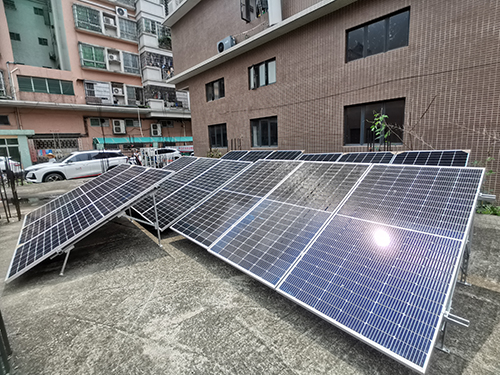
- 40KW solar power
| รายการ | ข้อมูลจำเพาะ |
|---|---|
| T360V-380V /40KW Off-grid inverter | GP40000/3P |
| Solar panel | 550W/42V |
| Battery | 2V500AH |
| combiner box | Two in one |
| solar rack | Two panels on 1 rack |
Solar seawater desalination machine maintenance:
Maintenance of reverse osmosis solar seawater desalination systems should focus on membrane component protection and energy system stability. Routine maintenance includes: rinsing the membrane surface with low-pressure product water for 20 minutes after each shift to prevent contaminant deposition; using acidic (citric acid) or alkaline (NaOH) cleaning agents every 3–6 months to remove inorganic/organic deposits, and testing membrane integrity (e.g., pressure retention tests). High-pressure pumps should be inspected monthly for lubricant and seals to ensure operating pressure remains stable at 6–8 MPa, preventing overpressure damage to the membranes. The pretreatment system should have its filter cartridges replaced regularly (when differential pressure exceeds 0.15 MPa) and scale inhibitors (e.g., HEDP) added to prevent scale formation in the concentrate stream. The solar power section requires weekly cleaning of photovoltaic panel surfaces and quarterly inspection of energy storage battery status (e.g., lead-acid battery electrolyte density) to ensure continuous power supply during cloudy or rainy weather.

Advantages of Solar-Powered Desalination Technology:
- Environmental Protection and Low Carbon
Completely powered by solar energy, with no reliance on fossil fuels, the process emits zero carbon during operation, significantly reducing negative environmental impacts. For example, the ‘Solar Dome’ project in Saudi Arabia has a water production cost of only 0.34 USD/m³, with no brine discharge, thereby avoiding damage to marine ecosystems. - Energy Efficiency
By converting solar energy into thermal energy (e.g., through light-absorbing materials) or directly powering reverse osmosis/distillation processes via photovoltaic generation, energy efficiency is improved by 30%-50% compared to traditional processes. Northeast University’s titanium-based light-absorbing material achieves an evaporation rate of 6.09 kg/m²·h, setting a world record. - Modularity and Flexibility
The equipment adopts a container-based design, enabling rapid deployment on islands or in remote areas. It has a small footprint (e.g., the Hainan solar thermal project occupies only 200 square metres) and supports multi-energy complementarity (e.g., wind, solar, and storage), adapting to complex environments. - Low Operating Costs
The average daily water production cost is reduced by 40%-60% compared to reverse osmosis, primarily due to the use of free solar energy and low maintenance requirements (e.g., no chemical agents needed, with membrane lifespan of 5-7 years).
What Are The Applications Solar Powered Desalination System?
- Islands and remote areas
Solves drinking water issues in areas without power grids or fresh water, such as the Maldives 5 residential island project, which achieves 24-hour stable water supply through a wind-solar complementary system, with a single unit producing 10 tonnes of water per day. - Coastal city emergency backup water source
Serving as an emergency water source during disasters such as typhoons and tidal surges, such as the Guangdong Dafeng Port Economic Development Zone project, which provides rapid deployment of freshwater supply for coastal industrial zones. - Agricultural irrigation and ecological water replenishment
Suitable for agriculture in arid regions, such as the Hainan solar thermal project, which produces 2,000 tonnes of distilled water annually for surrounding farmland, reducing groundwater over-extraction and enhancing crop yields. - Offshore Platforms and Vessel Supply
Provides freshwater for offshore drilling platforms and ocean-going vessels, reducing reliance on freshwater transportation. For example, a drilling platform in the Middle East uses a solar RO system with an average daily water production of 50 cubic metres. - High-Salinity Wastewater Reuse
Treating industrial high-salinity wastewater (e.g., from seawater aquaculture or chemical plants) for resource recovery. For example, a chemical plant in Shandong Province uses solar distillation technology to reduce wastewater salinity from 35,000 mg/L to below 500 mg/L.
รับโซลูชั่นทันที
Related Products

 Thai
Thai  English
  Arabic
  Spanish
  Russian
  Danish
  German
  Indonesian
  Romanian
  Vietnamese
  Turkish
  Italian