

Containerized ro systems moblie desalination plants
KYsearo’s containerized ro systems provide a full, pre-assembled, and examined water therapy plant mobile to basically any kind of location, functional promptly (hours/days). This “plug-and-play” strategy decreases extensive civil job, needing only standard site preparation
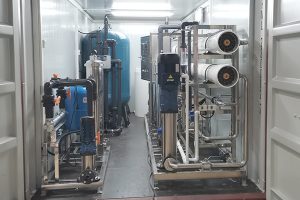
Containerized Reverse Osmosis (RO) systems are self-supporting water purification devices incorporated within conventional ISO delivery containers (10ft, 20ft, 40ft high dice). This layout supplies essential benefits: wheelchair and fast release.
- Portable and ease of installation
- Smaller footprint vs. traditional plants
- The container protects internal components from weather
- Modular design allows scalability by deploying multiple units
- Lower upfront costs, makes them cost-effective for remote uses.


Mobile/ containerized Reverse Osmosis system working principle:
Reverse Osmosis (RO), core to containerized systems, makes use of a semi-permeable membrane to divide dissolved solids and pollutants from water.Osmosis is water relocating from reduced to high solute focus throughout a membrane.
RO reverses this by applying outside stress going beyond osmotic stress to the high-concentration side.This forces water with the membrane layer, declining most liquified salts, organics, germs, and so on. Cleansed water is permeate; declined contaminations form concentrate/brine.
RO performance relies on the membrane. Commonly thin-film composite, membranes stabilize high water flux and excellent rejection. They work as a barrier, enabling water yet preventing bigger solutes/ions. Applied pressure overcomes osmotic stress and membrane layer resistance.
| Mặt hàng | Kích thước màng x Số lượng | Nước thấm (m3/D) | Tỷ lệ khử muối % | áp suất vận hành (Mpa) | Kích thước |
|---|---|---|---|---|---|
| KYCT20-60 | 8040×6 | 60 | 98 | 3.6-6.5 | 5850X2350X2380 |
| KYCT20-80 | 8040×8 | 80 | 98 | 3.6-6.5 | 5850X2350X2380 |
| KYCT20-100 | 8040×10 | 100 | 98 | 3.6-6.5 | 5850X2350X2380 |
| KYCT20-120 | 8040×12 | 120 | 98 | 3.6-6.5 | 5850X2350X2380 |
| KYCT40-60 | 8040×14 | 150 | 98 | 3.6-6.5 | 11850X2350X2380 |
| KYCT40-200 | 8040×16 | 200 | 98 | 3.6-6.5 | 11850X2350X2380 |
| KYCT40-250 | 8040×28 | 250 | 98 | 3.6-6.5 | 11850X2350X2380 |
| KYCT40-300 | 8040×28 | 300 | 98 | 3.6-6.5 | 11850X2350X2380 |
Containerize ro System Architecture and Key Components
Containerized RO systems are designed for compactness, efficiency, and ease of operation within a standard shipping container. Key components are skid-mounted, connected by piping/wiring to a central control board. Containers are customized with AC, lighting, etc., for environment/maintenance, sometimes including safety features.
Essential equipment includes:
- Hệ thống xử lý trước: Protects membranes from fouling/scaling by removing particles, solids, impurities. Includes:
- Multimedia Filtration (suspended solids).
- Chemical Dosing (coagulants, flocculants, pH).
- Softening (hardness ions).
- Disinfection (microorganisms, pre-chlorination), followed by Activated carbon (remove chlorine).
- Cartridge Filters (final particle removal) [before RO].
- RO Skid: Heart of system; high-pressure pump, membrane vessels, membranes.
- High-Pressure Pump (forces water through membranes), often with VFDs
- Membrane Pressure Vessels (house membranes, FRP).
- RO Membranes (separate dissolved solids), thin-film composites resist fouling.
- Pumps: Raw water booster pumps feed pre-treatment.
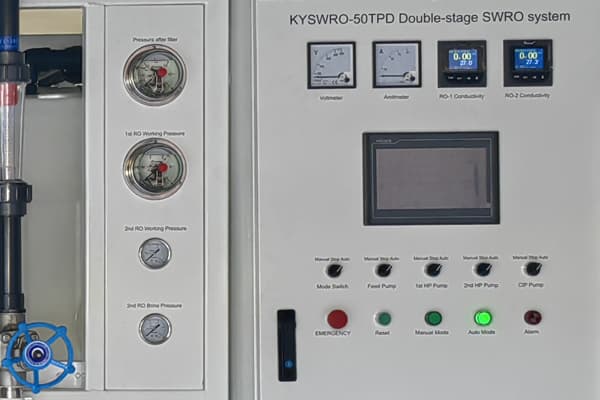
- Control System: Automated PLC/HMI systems for monitoring/operation. Enable automatic production, cleaning, remote control. Sensors monitor parameters.
- Post-treatment (Optional): Disinfection (UV, chlorination), pH adjustment, remineralization for specific quality.
How is the containersized ro systems operational process?
The functional process transforms raw water right into penetrate with a specified sequence involving each component.
- Source Water Intake: Raw water drawn from resource, commonly with booster pump
- Tiền xử lý: Safeguards membrane layers. Consists of filtration (multimedia), chemical dosing (pH, antiscalant), softening, sanitation (chlorination, after that carbon), cartridge filters [before RO]
- High-Pressure Pumping: Pump boosts pressure for RO. Pressure relies on salinity.
- Reverse Osmosis Splitting Up: High-pressure water enters membrane vessels. Water goes through membrane layer, declining impurities.
- Penetrate Collection: Detoxified water (permeate) collected, low in solids.
- Concentrate Discharge/Management: Water not going through membrane layer (concentrate/brine) discharged [additionally treatment feasible] ERDs recover energy [11-18]
- Post-treatment (if relevant): Further therapy (sanitation, pH, remineralization) for final quality.
- Control and Monitoring: Automated system checks specifications (flow, stress, high quality). Changes procedure, notifies variances.
Operational finest techniques maintain performance/longevity. Routine monitoring/adjustment of specifications (pressure, flow) is crucial. Optimizing recuperation (60-85% for brackish) equilibriums production/scaling danger. Effective pre-treatment takes care of feed quality, minimizes fouling.Routine evaluations, membrane layer cleaning, and filter/membrane replacement are important upkeep.
Nhận giải pháp ngay
How is Resource Water and Application Details Adjustments?
Containerized RO system layout relies on resource water quality and designated application. Various resources (salt water, briny, wastewater) call for details pre-treatment and membrane adjustments.
Brackish Water Adaptations: Brackish water (moderate salts) needs details pre-treatment to prevent membrane layer scaling/fouling.Scaling impurities include carbonates, sulfates, silica.Fouling issues are silt, microbes, organics. Brackish pre-treatment integrates filtration (multimedia, carbon, cartridge), softening, sanitation, and chemical dosing (antiscalants, coagulants). Acid/CO2 or antiscalants stop scaling. Briny RO elements run at lower stress (100-150 psi), frequently with bigger channels/spacers for silica/fouling control. Element/vessel design is critical.Recovery is restricted to 50-85% to manage scaling. Single-pass has reduced recuperation; two-pass increases recovery/scaling threat. Multi-stage enables intermediate dosing.
Salt water Adjustments: SWRO systems deal with high salinity, requiring higher pressures and specialized membrane layers. SWRO pre-treatment is critical/complex, involving robust filtration (occasionally UF) to get rid of solids/reduce fouling prior to RO.
Industrial Wastewater Treatment: Containerized RO treats commercial wastewater (oil/gas, mining, and so on), enhancing effluent high quality by removing microorganisms, TDS, nutrients, minerals. They get rid of solids, microbes, liquified solids, toxins to satisfy laws (approximately 99.7% salt elimination). Equipments adapt to diverse wastewater kinds (metropolitan, animals, natural, industrial biological)., occasionally including activated sludge for organic therapy .
Capability, Scalability, and Power Administration
Capacity is penetrate quantity per time (GPD/m TWO/ day). A 40ft system can produce up to one million GPD.
Scalability: Scalability is key by means of modular layout. Units come in different dimensions. Multiple units release in parallel for higher capacity. This modularity enables scaling capacity as requirements alter, staying clear of big permanent plants.
Energy Administration: Power usage is a substantial RO expense, particularly for high-pressure SWRO. Systems improve effectiveness to reduce expenditures.
Energy Recovery Devices (ERDs): ERDs are crucial for effectiveness, specifically in SWRO. They recover power from high-pressure concentrate, transferring it to feed water, lowering pump energy. Types include Isobaric Pressure Exchangers (transfer stress, e.g., Danfoss iSave, portable, high effectiveness ~ 94%, energetic control). and Energy Recovery Generators (recover energy from concentrate stress). ERDs bring about substantial energy cost savings (e.g., 57% decrease with Danfoss iSave, 70% recovery with Skyview UF-RO/ERD. ERD selection/performance variables consist of capability, feed variants, container space. ERDs are a substantial upfront cost balanced out by operational financial savings.
Combination with Renewable Resource: Possible exists for integrating renewable energy like solar. Solar-powered RO is energy-efficient/cost-effective, especially off-grid with PV reducing costs/environmental impact.
Advantages, Difficulties, and Release Circumstances
Containerized RO uses advantages for varied applications, specifically where typical facilities is doing not have. Obstacles exist.
Benefits: .
- Wheelchair & Rapid Implementation(Essential for emergency/temporary/remote
- Cost-Effectiveness (Lower upfront, scalable, affordable vs. acquiring water/discharging)
- Flexibility (Take care of various sources/qualities using pre/post-treatment)
- Environmental Sustainability (Energy-efficient tech, renewable combination)
- Minimal Site Prep & Pre-assembled/Tested (” Plug-and-play”, basic prep, ready for installation)
- Security & Rugged Construction (Container safeguards from weather/vandalism, built hard)
- Scalability (Modular style allows ability development)
Obstacles: .
- Possibly greater upkeep costs/lower integrity vs. repaired plants, highlighting requirement for durable maintenance.
- Logistical difficulties exist despite mobility, specifically in emergencies: Transport (heavy, remote locations), Site Preparation (standard), Configuration Time (hours/days), Sychronisation Specialized Devices (cranes), Protection
Implementation Circumstances: Ideal deployment scenarios:.
- Emergency Situation Response/Humanitarian Aid (Rapid tidy water throughout catastrophes, for displaced/workers)
- Military Workflow (Tidy water in remote/austere areas)
- Industrial Applications (Process/wastewater/potable water for short-lived sites, camps, offshore). Industries: oil/gas, mining, agriculture, hospitality, power, pharma, cosmetics, chemical
- Local Supply Of Water (Supplementing during drought/emergencies, small areas)
- Tourism/Hospitality (Freshwater for remote resorts)
- Environmental Remediation (Treating contaminated water)
- SMEs (Cost-efficient remedies)
Containerized RO convenience, mobility, rapid release make them important for diverse water needs/environments. Benefits commonly outweigh difficulties in scenarios requiring adaptable, rapidly deployable solutions, despite maintenance/logistical planning needs.
Get A Quote Today!
Relaterd Products

 Vietnamese
  English
  Arabic
  Spanish
  Russian
  Danish
  German
  Indonesian
  Romanian
  Turkish
  Thai
Thai  Italian