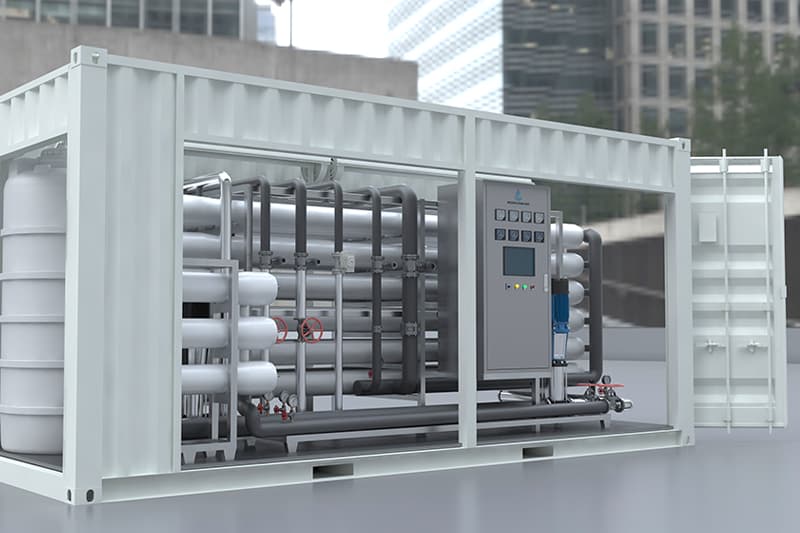

In modern industrial and water treatment fields, reverse osmosis technology has become a key method for obtaining high-purity water. This technology effectively removes various impurities from water through a physical separation process, meeting diverse needs ranging from drinking water preparation to high-tech industries. The following content provides a comprehensive analysis of all aspects of industrial ro plants.
How Is Industrial RO Plant?
Industrial ro plant refers to a system utilizing reverse osmosis technology for water treatment. Its core principle involves separating solvent and solute through a semi-permeable membrane under pressure. This system efficiently removes up to 99% of dissolved salts, organic compounds, bacteria, viruses, and other impurities from water, producing purified water. Suitable for large-scale industrial applications, the equipment can also be flexibly scaled to meet diverse user requirements for pure water.
What is the principle of reverse osmosis technology?
Reverse osmosis is a membrane separation process driven by pressure differential. It reverses the natural osmosis phenomenon: when an external pressure exceeding the osmotic pressure is applied to a high-concentration solution, water molecules are forced through the semipermeable membrane from the high-concentration side to the low-concentration side, while solutes are retained by the membrane. Osmotic pressure depends on solution concentration and temperature, calculated as π = iCRT, where i represents the number of ions formed by solute ionization, C denotes molar solute concentration, R is the molar gas constant, and T is absolute temperature. This physical process requires no heating or chemical additives, resulting in relatively low energy consumption.

Why Do Industrial Need Reverse Osmosis Water Treatment Systems?
Industrial ro plants are indispensable across numerous sectors, primarily because they deliver high-quality water that meets specific process requirements. In the electronics industry, reverse osmosis systems provide ultrapure water for semiconductor and integrated circuit production, achieving water resistivity as high as 18MΩ·cm. In the power industry, it treats boiler feedwater to ensure safe thermal system operation. The pharmaceutical sector relies on it to produce water for injection meeting pharmacopoeia standards. Furthermore, in food and beverage processing, seawater desalination, and wastewater reuse, reverse osmosis systems play a critical role in enhancing water quality, conserving resources, and protecting the environment.
What is the separation mechanism of reverse osmosis membranes?
Reverse osmosis membranes achieve separation primarily through three effects: sieving effect, dissolution-diffusion mechanism, and charge repulsion. The micropores on the membrane surface typically range from 0.1 to 1 nanometer in diameter, effectively blocking ions and organic molecules larger than 100 molecular weight. Simultaneously, most reverse osmosis membranes carry a negative charge, which further repels negatively charged ions through electrostatic repulsion, thereby increasing salt rejection rates. Reverse osmosis membranes effectively filter out Pseudomonas aeruginosa (one of the smallest bacteria at 3000×10⁻¹⁰ meters), various viruses such as influenza virus (800×10⁻¹⁰ meters), and pyrogens (10-500×10⁻¹⁰ meters).
What Are The Components For Industrial RO Plant?
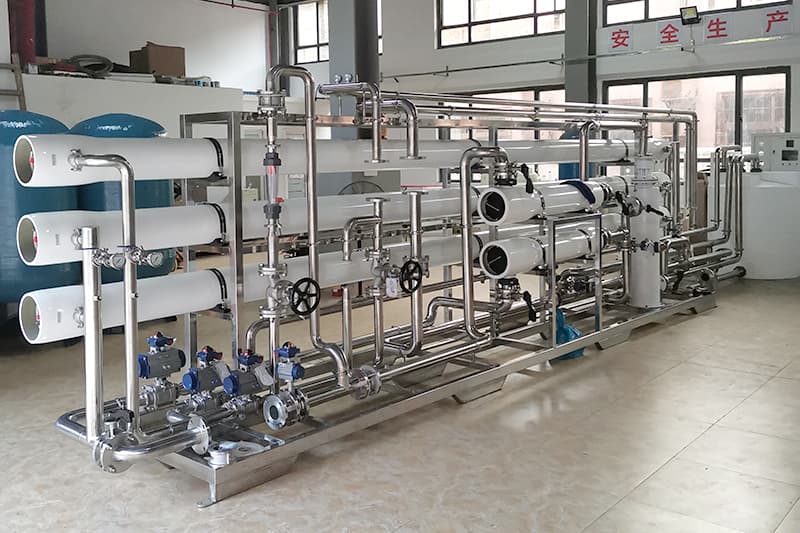
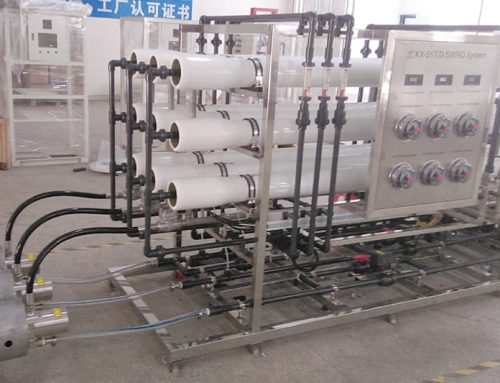
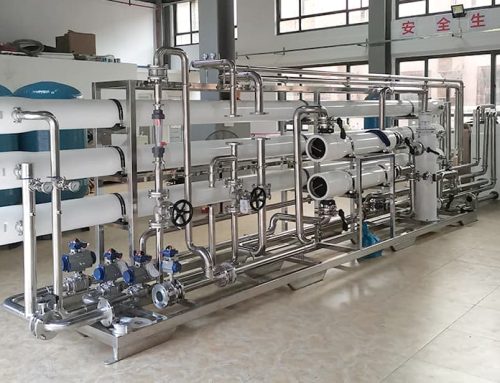
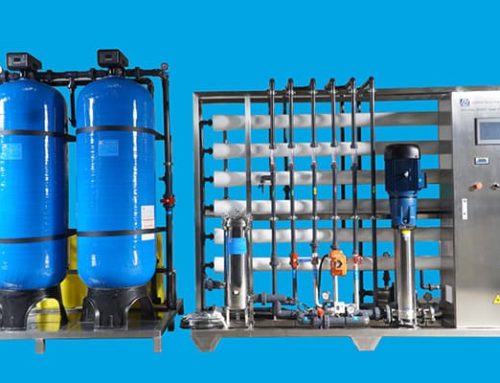
A complete industrial ro plant typically comprises three major components: the pretreatment system, the reverse osmosis core system, and the post-treatment system. The pretreatment system generally includes a multimedia filter, activated carbon filter, and precision filter (security filter) to remove suspended solids, colloids, organic matter, residual chlorine, and other substances that could contaminate the reverse osmosis membrane. The core of the reverse osmosis system comprises high-pressure pumps and reverse osmosis membrane modules. High-pressure pumps deliver the required pressure (typically 1.5–10.5 MPa), while membrane modules perform the critical separation function. The post-treatment system may include UV sterilizers, EDI modules, or mineralization units to further optimize water quality. Control systems and cleaning systems ensure automated operation and regular maintenance of membrane elements.

What are the working flow of a ro plant?
The standard workflow begins with raw water pretreatment. Raw water undergoes pretreatment through media filters, activated carbon filters, etc., to meet reverse osmosis feed requirements (e.g., SDI < 5, residual chlorine < 0.1 mg/L). The pretreated water is pressurized by the high-pressure pump and enters the reverse osmosis membrane assembly, where it separates into permeate (purified water) and concentrate (wastewater) within the membrane. The permeate proceeds to subsequent treatment or direct use, while a portion of the concentrate is recycled to enhance recovery rates, with the remainder discharged. The system automatically initiates cleaning cycles based on pressure differential or permeate flow rate variations to ensure stable operation.
What are the advantages of industrial ro plant?
The key advantages of industrial reverse osmosis equipment lie in its high purification efficiency, low energy consumption, and environmental sustainability. It efficiently removes the vast majority of impurities from water, achieving desalination rates of 95%-99.7%. The reverse osmosis process operates at ambient temperatures without phase changes, resulting in low energy consumption. Compared to traditional ion exchange methods, reverse osmosis eliminates the need for acid/alkali regeneration, avoiding the discharge of chemical waste liquids and offering greater environmental friendliness. The equipment features a compact structure, high automation, simple operation, and stable product water quality.
How to Maintain and Service a RO plant?
Effective maintenance of a reverse osmosis system relies on regular cleaning, monitoring parameters, and timely replacement of consumables. Chemical cleaning is required when the system pressure differential increases by 15% or the water production rate decreases by 10%. Common cleaning agents include citric acid and EDTA. Daily monitoring of parameters such as pressure, flow rate, and conductivity is essential, with thorough record-keeping. Filtration media in pretreatment systems, such as quartz sand and activated carbon, require periodic backwashing and replacement (quartz sand typically every 10-24 months, activated carbon every 10-12 months). Precision filter cartridges are usually replaced every 3-6 months. Reverse osmosis membrane elements should be replaced promptly at the end of their service life (e.g., when salt rejection falls below 90% or performance cannot be restored after multiple cleanings).
What are the application of industrial ro plant?
Reverse osmosis technology has extensive applications. The following table summarizes its main application areas and typical uses:
| Application | Typical Use | Water Quality Requirements/Characteristics |
|---|---|---|
| Power Industry | Boiler feedwater, cooling water purification | Ensuring safe thermal system operation, preventing scaling and corrosion |
| Electronics Industry | Ultra-pure water preparation for semiconductors, ICs | Water resistivity up to 18 MΩ·cm |
| Pharmaceutical Industry | Water for Injection (WFI), Process Water | Meets pharmacopoeia standards |
| Food & Beverage | Mineral Water Purification, Juice Concentration, Dairy Processing | Ensures product safety and taste |
| Seawater Desalination | Freshwater Supply for Islands, Vessels, Coastal Areas | Desalination rate over 99%, electricity consumption per ton reduced to below 3kWh |
| Wastewater Reuse | Electroplating, dyeing wastewater treatment, landfill leachate treatment | Enables wastewater reuse or near-zero discharge |
| Municipal Water Supply | Enhances drinking water quality, removes harmful substances | Ensures public drinking water safety |
What Parameters Should Be Considered When Selecting Industrial Ro Plant?
When selecting industrial reverse osmosis equipment, focus on critical parameters such as desalination rate, recovery rate, and membrane flux. Desalination rate indicates the membrane’s ability to remove dissolved salts, typically requiring 95%-99.7% in industrial systems. Recovery rate is the ratio of product water flow to feed water flow, generally ranging from 50% to 85% in industrial systems. Increasing recovery rate reduces wastewater discharge but heightens membrane fouling risks. Membrane flux is the water production per unit membrane area per unit time; excessively high design flux accelerates membrane fouling. Operating pressure must be determined based on feedwater salinity and temperature. Seawater desalination systems may operate at pressures of 5.5–8 MPa, while brackish water treatment systems typically run at 1.5–4 MPa.
How can energy consumption and recovery rate be optimized in ro plants?
Optimizing energy consumption and recovery rate in reverse osmosis systems can be achieved through the use of energy recovery devices, optimized system design, and reasonable control of operating parameters. Next-generation equipment incorporates energy recovery devices that reuse up to 90% of the pressure energy from concentrate water, reducing system power consumption to below 2.5 kWh/m³. Multi-stage membrane element configurations (e.g., 2:1 or 4:2:1 stage designs) optimize recovery rates, enabling large-scale systems to achieve 75% or higher recovery. Specialized RO equipment for high-salinity wastewater treatment incorporates innovative concentrate recirculation designs to further elevate overall recovery rates.
As a highly efficient, energy-saving water treatment technology, industrial reverse osmosis equipment requires comprehensive consideration of operating principles, component functions, application requirements, and key parameters during selection, deployment, and maintenance. With technological advancements, reverse osmosis systems are progressing toward lower energy consumption, higher recovery rates, and greater intelligence, continuously supporting solutions to global water resource challenges.
Get A Free Quote Today!
 Thai
Thai  English
  Arabic
  Spanish
  Russian
  Danish
  German
  Indonesian
  Romanian
  Vietnamese
  Turkish
  Italian