
In the face of global water scarcity, Chinese seawater desalination plant manufacturers are promoting industrial development through technological innovation and providing key solutions to ensure water resource stability;
As one of the largest demanders of freshwater resources globally, seawater desalination has become a primary means of addressing water resource emergencies in China. With the shortage of water resources and the increasing awareness of environmental protection, China’s seawater desalination plant industry has developed rapidly in recent years, with the market size continuously expanding and the compound annual growth rate (CAGR) increasing year by year!
Overview of China’s seawater desalination industry
China’s seawater desalination plant industry is in a stage of rapid development, and the market field is constantly expanding. The government’s emphasis on water resource security and environmental protection has spurred the implementation of seawater desalination projects, and introduced a series of encouragement and support strategies, tax incentives, etc., providing a good policy environment for the development of the industry!
In terms of technological progress, China has made remarkable progress in various fields such as reverse osmosis membrane technology, electrodialysis, and distillation. The improvement of independent research and development capabilities has made domestic equipment more competitive in terms of cost and technology. There are 158 seawater desalination projects nationwide, with a total capacity of 2.856 million tons per day, of which reverse osmosis technology accounts for 68.25%. According to the “Seawater Desalination Development Action Plan (2021-2025)”, the total national seawater desalination target will reach 2.9 million tons per day!

How does seawater desalination plant work?
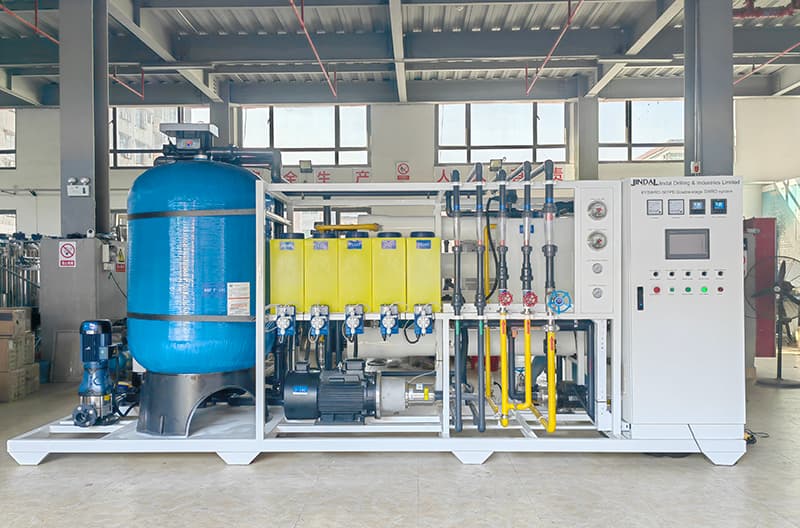
Seawater desalination plant is an industrialized device that removes salt from seawater through physical or chemical methods. It mainly consists of three parts: a pretreatment system (to remove suspended solids), a main processing system (distillation/reverse osmosis and other desalination methods), and a post-treatment system (water purification and disinfection);
The mainstream seawater desalination technology mainly includes two major categories: thermal desalination and membrane desalination:
Thermal technology
These mainly include Multi-Effect Distillation (MED) and Multi-Stage Flash (MSF)! These processes work by heating seawater to evaporate it, and then condensing the steam to obtain freshwater;
Membrane technology
Mainly represented by reverse osmosis (RO) technology, which uses a semipermeable membrane that allows only solvent to pass through but not solute, to separate water and salt in seawater under external pressure. The biggest advantage of reverse osmosis is energy saving, with energy consumption only being 1/2 of electrodialysis and 1/40 of distillation!
The basic process of seawater desalination is: seawater is filtered by a water supply pump into a quartz sand (multi-media filter) and activated carbon filtration system. After filtration, the water is subjected to water quality reduction, pH adjustment, and scale inhibitor supplementation, and then enters a tight and secure filtration system. It is then pressurized by a high-pressure pump and enters a reverse osmosis membrane stack system!
Under the treatment of membrane stack, a part of water is brewed into fresh water through membrane, and stored in fresh water tank after water quality adjustment! The remaining high-pressure concentrated water enters the pressure exchange energy recovery assembly to receive energy and then discharged.
 Setting up focus components and key technologies
The core components of seawater desalination plant include:
- High-pressure pump: A power device that provides the required pressure for reverse osmosis preparation. There are mainly two types: multistage centrifugal pumps for energy-type pumps and plunger pumps for positive displacement pumps!
- Energy acceptance assembly: It recovers the pressure energy of concentrated seawater, reduces energy consumption, and is an important energy-saving device in reverse osmosis seawater desalination.
- Reverse osmosis membrane element: the core component of seawater desalination, with high desalination rate, corrosion resistance and other characteristics;
- Pre-treatment preparation: A multi-media filter, activated carbon filter, and cartridge filter are used to remove suspended solids, organic matter, and other impurities from seawater.
Chinese seawater desalination plant manufacturers have made remarkable progress in the research and development and production of these key components. For example, Shougang Jingtang United Iron & Steel Co., Ltd. has developed the “cogeneration of hydropower and electricity” technology, which directly couples the steam turbine generator unit and the seawater desalination plant. Compared with the steam extraction mode of conventional power plants, the overall thermal efficiency of power generation and seawater desalination has increased from 30% to 81.5%, and the energy consumption cost of seawater desalination has been reduced by about 50%.
 Major seawater desalination plant manufacturers in China
The following are some of the key players in the seawater desalination plant industry in China, organized by sector:
The following is an overview of some of the major domestic manufacturers of seawater desalination plant and their unique features (note: the information below is based on publicly available data and is not ranked in any particular order):
| Manufacturer Name | Core Technology/Features | Typical Application Fields | Innovation Highlights/Projects |
|---|---|---|---|
| Guochen Group | Industrial waste heat recovery, variable condition jet pump, modular design | Coastal nuclear power plants, industrial parks | Cost reduced to about 4 yuan/ton, cooperation with nuclear power, modular design saves 15% of initial investment |
| Shougang Jingtang United Iron & Steel Co., Ltd. | Multi-effect distillation (MED), “hydro-power symbiosis” capability | Steel, electricity and other high water consumption industries | Heat efficiency increased to 81.5%, localization rate of 98% |
| Qingdao Huaou Seawater Desalination Co., Ltd. | Both low-temperature multi-effect (thermal method) and reverse osmosis (membrane method) technologies are available | Municipal water supply, industrial water use | One of the largest reverse osmosis projects in China in terms of single unit capacity |
| Shangtuo Environment | Low temperature multi-effect preparation, large operational flexibility | Drinking water for coastal urban residents, water supply for island tourist areas, and water supply for offshore platforms | Low preparation consumption, high thermal efficiency |
| Guangzhou Kangyang Seawater Desalination Treatment Co., Ltd. | Integrated System of Seawater Desalination and marine seawater desalination device | Islands and remote areas; deep-sea fishing, merchant shipping, military vessels | New energy desalination of seawater, complete equipment for 2-2000 ton desalination of seawater |
These enterprises have their own advantages in technology research and development, product quality, project implementation and after-sales service, not only occupy a dominant position in the domestic market, but also actively expand overseas markets and participate in international competition..
Advantages and Technological Innovation
Seawater desalination plant manufacturers have several advantages:
- Cost advantage: For example, Guochen Group has reduced the cost of seawater desalination from 12 yuan per ton to around 4 yuan per ton, which is equivalent to a reduction of two-thirds, by utilizing industrial waste heat recovery capabilities!
- Modular design: The modular design allows the equipment to be pre-assembled in the factory and then assembled on-site within two days, saving 15% of the initial investment compared to traditional setups.
- Energy efficiency: The “hydropower symbiosis” technology developed by Shougang Jingtang United Iron & Steel Co., Ltd. has increased the overall thermal efficiency of power generation and seawater desalination from 30% to 81.5%;
- Intelligent operation: It has a high degree of automation, and can immediately stop in case of any blockage, with voluntary and effective protection.
In terms of technological innovation, Chinese seawater desalination plant manufacturers continue to promote the application of new materials, such as graphene-based membranes, basalt fiber photothermal membranes and other new materials that can improve desalination efficiency, and spiral nanoporous graphene membrane technology that achieves 100% salt rejection rate.
Manipulation Scenarios and Typical Cases
Seawater desalination is widely used in various fields:
- Urban water supply: especially in coastal areas and local cities with severe water shortage, seawater desalination has become an important way to ensure stable water supply;
- Industrial production: used in high water consumption industries such as chemical and steel production. For example, Kysearo uses seawater desalination to ensure water supply for steel production.
- Island water supply: Provide stable and reliable drinking water sources for islands with scarce freshwater resources.
- Ship and offshore platform: provide fresh water supply for ocean-going ships, drilling platforms, etc;
- Emergency water supply: providing emergency drinking water sources in natural disasters or emergencies;
Typical cases include: the first phase of the seawater desalination plant in Tseung Kwan O, Hong Kong, which can produce 135,000 cubic meters of fresh water daily upon completion, meeting 5% of Hong Kong’s fresh water demand. The seawater desalination project of Shougang Jingtang United Iron & Steel Co., Ltd., with a daily production capacity of 50,000 tons in the first phase and 35,000 tons in the second phase, stands as the largest single seawater desalination facility in China!
Frequently Asked Questions (FAQ)
The cost of seawater desalination varies depending on the technology used, the location, and the scale of the project. On average, the cost of desalination can range from $2 to $100 per cubic meter of desalinated water. However, some desalination projects can cost significantly more, with some estimates putting the cost at over $100 per cubic meter The cost of seawater desalination has dropped to 0.$6-0.8/ton, and its economic feasibility has been greatly improved. Some advanced enterprises such as Guochen Group can even control the cost at around 4 yuan/ton!
2. Can desalinated water be consumed directly?
After proper post-treatment, seawater desalination water can fully meet drinking water standards! For example, “Huaou Seawater” produced by Shougang Jingtang United Iron & Steel Co., Ltd. is purified water sourced from seawater desalination product water, suitable for healthy drinking water standards!
3. Is the seawater desalination system prone to scaling and corrosion?
Seawater has strong corrosivity and is prone to scaling. However, these issues can be effectively addressed through the selection of appropriate materials (such as corrosion-resistant materials) and pre-treatment processes!
The process of seawater desalination can have an impact on the environment, particularly in terms of energy consumption and the release of chemicals used in the desalination process. Additionally, the extraction and disposal of seawater can also have an impact on marine ecosystems and biodiversity. However, with careful planning and management, the environmental impacts of seawater desalination can be minimized During the process of seawater desalination, concentrated brine is produced. If directly discharged, it can have a significant impact on the local marine environment. However, many companies have developed comprehensive utilization technologies for concentrated brine, such as supporting chemical alkali production from concentrated brine, which not only solves the problem of mixed discharge but also brings better economic benefits;
5. What is the level of China’s seawater desalination technology in the world?
The seawater desalination technology of Huaxia has reached the international advanced level. Some technologies, such as the “hydropower symbiosis” ability of Shougang, are even the first application in the world’s large-scale thermal seawater desalination plant! Domestic equipment not only meets domestic needs, but also exports to water-scarce regions such as the Middle East and Southeast Asia;
With the continuous progress of technology and the leadership of strategy, the seawater desalination plant industry will develop towards the goal of integration and greening; seawater desalination will also develop into an energy acceptance system while desalinating seawater, achieving dual utilization of resources.
In terms of strategic support, the country has introduced a series of strategies, such as the “Action Plan for the Development of the Seawater Desalination Industry”, which provides clear development guidance and financial support for the seawater desalination industry! From the Third Plenary Session of the 20th Central Committee of the Communist Party of China, which proposed “improving the mechanism for promoting the development of the marine economy”, to the government work report, which clearly stated “vigorously developing the marine economy and building a demonstration area for the development of the marine economy”, a series of strategies have pointed out the direction for the development of the industry.
The desalination plant industry in China is in a stage of rapid development and is expected to become an important force in supporting national water resource security and environmental protection strategies. These manufacturers not only contribute to solving the problem of water scarcity in China, but also provide a Chinese solution and Chinese wisdom for global water resource security!
Get The Solution Today!


 Arabic
  English
  Spanish
  Russian
  Danish
  German
  Indonesian
  Romanian
  Vietnamese
  Turkish
  Thai
Thai  Italian


